
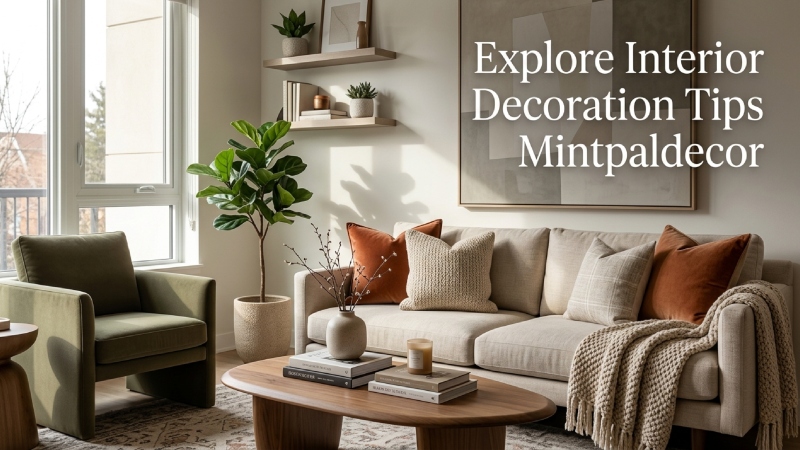
Walk into any beautifully decorated home and you’ll notice something strange — nothing about it feels accidental. The sofa sits exactly where conversation flows best. The light falls softly in layers instead of glaring from one ceiling bulb. Even the empty corners look deliberate. That quiet sense of “everything belongs here” is not luck, and it is definitely not money. It is method. Interior decoration tips Mintpaldecor?
Interior decoration tips Mintpaldecor is built around that method. Instead of chasing expensive furniture or copying showroom displays, this approach teaches you how professional stylists actually think: plan the space first, lock the color palette second, arrange furniture around a single focal point, layer your lighting, and finish with texture and personality. Whether you live in a compact apartment or a sprawling family house, these interior design tips Mintpaldecor will help you build a home that looks curated, feels comfortable, and works for real life — without draining your savings.
Quick Answer: What Are Interior Decoration Tips Mintpaldecor?
Interior decoration tips Mintpaldecor is a practical, beginner-friendly home styling framework that combines a neutral color palette, smart furniture placement around one focal point, layered lighting design, and affordable decorative accessories. The goal is simple: create a stylish, functional, and cozy living space using what you have — plus a few strategic upgrades — instead of an expensive renovation.
Stop Shopping First: Why Every Stunning Room Starts With Space Planning
Space planning is the process of measuring and mapping your room layout before you buy, move, or hang anything. It sounds boring. It is also the single step that separates magazine-worthy rooms from expensive mistakes.
Most decorating failures are actually shopping failures. Someone falls in love with a giant sectional sofa, hauls it home, and watches it swallow the entire living room. The Mintpaldecor home decoration philosophy flips that script: the room decides what fits, not the store display.
Here’s how to do it in under an hour. Measure the length, width, and ceiling height of the room. Mark where windows, doors, radiators, and power outlets sit. Note which direction natural lighting enters during morning and evening — this decides where your reading chair and indoor plants should live. Then sketch a rough room layout on paper or drop the dimensions into a free floor-planning app.
One rule matters more than all others: protect your walkways. Keep main walking paths between 75 and 90 centimeters wide. A room can hold beautiful furniture and still feel suffocating if people have to sidestep around a coffee table. A functional interior is one your body moves through without thinking — and that ease is planned, never purchased.
The 60-30-10 Color Palette Formula Professionals Never Share for Free
A color palette is the fixed set of hues that governs every decorating decision in a room — walls, furniture, textiles, and accessories. Get this right and even budget-friendly decor looks expensive. Get it wrong and designer furniture looks chaotic.
Modern interior decoration tips rely on a formula professionals have used for decades:
- 60% — Dominant neutral colors. Walls, large furniture, and flooring carry soft whites, warm greys, cream, or beige. Neutrals form the quiet backdrop that lets everything else shine.
- 30% — Secondary tone. Curtains and textiles, an area rug, bedding, or an accent chair introduce your room’s personality color — think sage green, dusty blue, or warm taupe.
- 10% — Accent colors. Cushions, artwork, vases, and small decorative elements deliver bold punches — terracotta, navy, mustard, or brass.
Why does this work? Because the human eye reads repetition as intention. When your accent color appears three or four times across a room — a cushion, a frame, a ceramic bowl — the brain registers harmony. Home interior decoration ideas collapse most often at this exact step: five competing colors fighting for attention destroy interior harmony before a single accessory earns its place.
Pro move: if you fear commitment, keep your 60% and 30% layers calm and timeless, then rotate your 10% accents seasonally. New cushion covers and a throw cost a fraction of repainting, and your room feels reborn every few months.
Furniture Placement Secrets: Arrange Around One Focal Point and Watch the Room Click
A focal point is the single visual anchor a room organizes itself around — a fireplace, a large window with a view, statement furniture, or one commanding piece of wall decor. Every stylish living room you’ve ever admired has exactly one. Rooms that feel “off” usually have three competing ones, or none at all.
Once you’ve chosen yours, these practical interior design tips handle the rest:
Pull furniture off the walls. Shoving every piece against the wall is the most common mistake in home decorating. Floating your sofa even 10–15 centimeters into the room creates instant breathing space and makes the layout look deliberate rather than default.
Build a conversation zone. Seating should face inward, with sofas and chairs positioned within roughly 2.5 meters of each other. People should talk without raising their voices.
Respect negative space. Empty floor is not wasted space — it is the pause that lets the eye appreciate what is there. A room packed with furniture reads as storage, not style.
Anchor with a rug. Place the rug so at least the front legs of your seating rest on it. This visually glues the arrangement into one zone and adds your first layer of texture in a single move.
Small room decorating demands one extra discipline: scale beats quantity. Choose fewer, leaner pieces — sofas with exposed legs, nesting tables, storage ottomans, wall-mounted desks. Visible floor beneath furniture tricks the eye into reading the room as larger than it is.
Lighting Design in Three Layers: The Trick That Makes Cheap Rooms Look Luxurious
Lighting design is the deliberate layering of ambient, task, and accent light so a room feels warm, dimensional, and alive at any hour. Rely on one overhead bulb and everything flattens — colors turn dull, corners die into shadow, and even beautiful furniture looks tired.
The fix costs far less than new furniture:
- Ambient lighting — your base layer. Ceiling fixtures, pendant lights, or recessed spots that provide overall illumination.
- Task lighting — focused light where work happens: a reading lamp by the armchair, under-cabinet strips in the kitchen, a desk lamp in the study corner.
- Accent lighting — the drama layer. Picture lights over artwork and mirrors, LED strips behind shelves, a candle cluster on the mantel. This layer creates depth and mood.
Never underestimate natural lighting. Hang a large mirror directly opposite a window and you effectively double your daylight. Swap heavy drapes for sheer curtains and textiles that filter rather than block the sun. Keep sills clear of clutter.
One detail professionals obsess over: bulb temperature. Warm light (2700–3000 Kelvin) builds a cozy living space perfect for bedrooms and lounges. Cool white light belongs in kitchens and work areas. Mixing them randomly is why some homes feel subtly uncomfortable — and almost nobody can explain why.
Texture Layering and Decorative Accessories: Where Your Home Finally Gets a Personality
Texture layering is the practice of combining contrasting surface materials — rough against smooth, matte against soft — so a room gains depth that color alone cannot provide. This is the stage where modern home decor ideas stop looking like a catalogue and start looking like you.
Work through these layers in order:
Rugs and cushions first. Mix materials boldly — a jute rug under a velvet cushion, linen beside wool, faux leather against soft cotton. Contrast is the entire point.
Soft furnishings next. Drape a throw casually over the sofa arm. Fold a second at the foot of the bed. These small gestures signal comfort instantly and cost very little.
Indoor plants for life and height. One tall floor plant (a fiddle-leaf fig or areca palm) anchors an empty corner; a small tabletop cluster softens shelves. Group plants in odd numbers — three reads as styled, four reads as a lineup.
Wall decor at eye level. Hang artwork and mirrors with their center roughly 145–152 centimeters from the floor — gallery standard. Odd-number groupings of frames feel curated; symmetrical grids feel formal. Pick one mood per wall.
Minimalist decor discipline last. For every new decorative accessory that enters the room, consider removing one. Clutter is just decoration that lost its editor.
Comparison Table: Mintpaldecor Method vs. Random Decorating
| Decorating Decision | Random Approach (Common Mistakes) | Mintpaldecor Method (Pro Result) |
| Starting point | Buy first, plan later | Measure and map the room layout first |
| Color palette | Whatever looks good in-store | Fixed 60-30-10 neutral-to-accent formula |
| Furniture placement | Everything pushed to walls | Floating layout around one focal point |
| Lighting design | Single overhead bulb | Ambient + task + accent layers |
| Accessories | Bought in bulk, displayed all at once | Edited pieces, odd-number groupings |
| Budget usage | Big spend on trendy items | Thrift, repaint, restyle — spend on anchors |
| Final result | Cluttered, flat, quickly dated | Cohesive, cozy, timeless modern home style |
Room-by-Room Action Plan: Your Mintpaldecor Styling Checklist
Theory means nothing until it hits your actual rooms. Use this checklist as your weekend roadmap — each step is an affordable home decoration idea you can execute in hours, not weeks.
| Room Zone | Do This First | Quick Win Under a Small Budget |
| Living Room | Define focal point, float the sofa | New cushion covers + one tall indoor plant |
| Bedroom decoration | Calm 60% neutrals, blackout + sheer curtain combo | Layered bedding with two textures of throws |
| Kitchen / Dining | Add task lighting under cabinets | Styled open shelf: 3 items, varied heights |
| Small Room | Measure layout, choose leggy furniture | Large mirror opposite the window |
| Entryway | Clear walkway of 75–90 cm | Wall hooks + a slim console with one artwork |
| Whole Home | Warm bulbs (2700–3000K) everywhere | Edit surfaces: remove one item per shelf |
Work one zone at a time. Finish it completely before moving on. Momentum — not money — is what transforms homes.
The 5 Deadly Decorating Mistakes That Secretly Make Your Home Look Cheap
Even solid interior design ideas for home get sabotaged by a handful of repeat offenders. Audit your space against these:
- The single light source. One ceiling bulb flattens every texture you paid for. Add a floor lamp and a table lamp before buying anything else.
- Furniture glued to walls. It feels safe; it looks accidental. Float your key pieces and claim the room.
- Rugs that are too small. A tiny rug floating in the middle of a seating area shrinks the whole room visually. Go bigger — front legs on, always.
- Artwork hung too high. Pictures near the ceiling disconnect from the furniture below them. Eye level. Every time.
- Ignoring negative space. When every surface carries something, nothing gets seen. Empty space is a design tool, not a failure to decorate.
Fix even three of these this weekend and visitors will ask what you renovated. The answer — nothing — is the best part.
Frequently Asked Questions (FAQs)
What are interior decoration tips Mintpaldecor?
Interior decoration tips Mintpaldecor is a step-by-step home styling framework covering color palettes, furniture placement, layered lighting, and budget-friendly accessories. It focuses on creating a stylish, functional interior without renovation or professional fees.
How do I start decorating my home as a complete beginner?
Start with space planning — measure your room and sketch a layout before buying anything. Then lock a 60-30-10 color palette, position furniture around one focal point, and layer lighting and texture afterward.
What does the 60-30-10 interior design rule mean?
The 60-30-10 rule divides a room’s colors into 60% dominant neutrals, 30% a secondary tone, and 10% accent colors. This ratio creates visual balance and prevents competing hues from clashing.
How can I decorate my home on a tight budget?
Prioritize high-impact, low-cost upgrades: cushion covers, throws, indoor plants, mirrors, warm bulbs, and restyled shelves. Repaint or thrift anchor pieces instead of replacing them — modern interior decoration tips prove layout and lighting matter more than price tags.
How do I make a small room look bigger?
Use light neutral colors, furniture with exposed legs, a large mirror opposite the window, and sheer curtains to maximize natural lighting. Keep walkways clear and honor negative space — visible floor reads as open space.
Where should I place furniture in a living room?
Arrange seating around one focal point — a fireplace, window, or statement furniture — within conversational distance of about 2.5 meters. Float pieces slightly off the walls and anchor the zone with a properly sized rug.
What are the best lighting design tips for a cozy home?
Layer three types of light: ambient (ceiling), task (reading and work lamps), and accent (picture lights, LED strips, candles). Use warm bulbs between 2700K and 3000K in living areas and bedrooms for a cozy living space.
What’s the best way to select a color scheme for my home?
Pick one dominant neutral for 60% of the room, a secondary personality tone for 30%, and a bold accent for the final 10%. Repeat the accent color at least three times across cushions, artwork, and decorative elements so the room reads as harmonious.
What are the most common interior decorating mistakes?
The most common mistakes are relying on one overhead light, pushing all furniture against walls, using rugs that are too small, hanging artwork too high, and filling every surface with accessories. Each has a fast, free fix.
How can I make my home look stylish without hiring a designer?
Follow a method instead of trends: plan the layout, fix the palette, anchor furniture to a focal point, layer lighting and texture, then edit ruthlessly. Stylish home decoration tips all reduce to those five disciplined steps.
Final Word: Great Homes Are Edited, Not Bought
The homes people remember aren’t the most expensive ones — they’re the most intentional ones. Interior decoration tips Mintpaldecor hands you that intention as a repeatable system: measure before you shop, commit to a 60-30-10 color palette, let one focal point lead your furniture arrangement, build lighting in three warm layers, and finish with texture, greenery, and carefully edited accessories.
You don’t need to do everything this week. Pick one room. Apply one layer. Then the next. Interior harmony is built the same way trust is — gradually, deliberately, and one honest decision at a time. Start tonight with the easiest win on the checklist: swap a bulb, float a chair, hang that mirror opposite the window. Your home has been waiting for you to decorate it on purpose.
Visit blogblueflamepublishing for more details.