
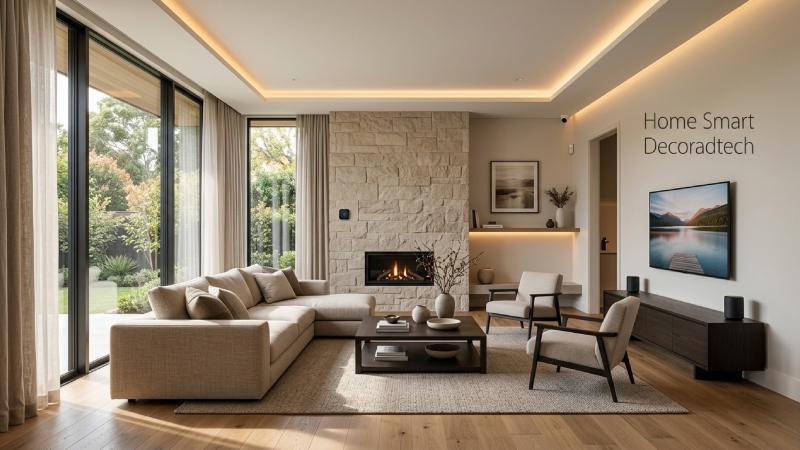
Most smart homes fail the eye test. The technology works, but the room suffers—a plastic camera on the bookshelf, cables drooping behind the TV, a speaker that matches nothing. Home smart decoradtech fixes this by treating smart home technology and interior design as a single discipline. Every device earns its place twice: once for what it does, and once for how it looks doing it.
The timing couldn’t be better. The global smart home market was valued at roughly $162.8 billion in 2025 and is projected to reach $207 billion in 2026, according to Grand View Research. That growth is pushing manufacturers to build devices people actually want to look at.
This guide breaks down what decoradtech means in practice, which smart home upgrades deliver measurable value, and how to plan an intelligent home design that ages well.
Quick Answer: What Is Home Smart Decoradtech?
Home smart decoradtech is a design-first approach to home automation where connected devices—lighting, climate, blinds, speakers, security—are selected and installed to complement a home’s aesthetic. The technology stays powerful but visually discreet, hidden in walls, ceilings, and furniture rather than displayed as gadgets.
Home Smart Decoradtech at a Glance
Table 1 — Key Summary (2026 Data)
| Aspect | Detail |
| Definition | Smart home technology integrated into interior design |
| Market size (2026) | ~$207 billion globally, per Grand View Research |
| Best first upgrades | Smart lighting + smart thermostat |
| Starter budget | $200–$500; $2,000+ for whole-home integration |
| Documented energy savings | ~8% on heating/cooling bills (ENERGY STAR) |
| Resale impact | Smart features can lift resale value up to ~5% (CEDIA/NAR research) |
| Core principle | Hide the hardware, keep the intelligence |
Why Smart Home Design Became a Real Discipline
Smart home technology was originally sold on specifications. Protocols. App features. Nobody asked how a device looked next to the sofa.
Manufacturers learned the hard way that adoption stalls when devices fight the room. The 2026 product landscape reflects that lesson: fabric-wrapped speakers, flush-mount sensors, thermostats in metal finishes, and motorized shades with hidden motors. The Matter interoperability standard—now rolling out across Amazon, Apple, Google, and Samsung SmartThings devices—has accelerated this shift by letting buyers choose products for design rather than ecosystem lock-in.
The financial case strengthened too. ENERGY STAR reports that certified smart thermostats save an average of 8% on heating and cooling bills—around $50 per year for a typical US household. Research cited by CEDIA and the National Association of Realtors suggests integrated smart features can enhance resale value by up to 5%. Design-led tech isn’t decoration. It’s an asset.
The Core Elements of Intelligent Home Design
Smart Lighting: The Foundation Layer
Smart lighting delivers the highest visible impact per dollar in home technology integration. Automated lighting scenes shift a room from task mode to evening mode instantly, and tunable white light changes how paint, wood, and fabric read throughout the day.
For a decoradtech finish, prioritize recessed fixtures, cove-mounted LED strips, and under-shelf lighting over exposed smart bulbs. The light should be seen. The source should not.
Smart Thermostats and Zoned Climate
A smart thermostat is the rare upgrade that pays for itself—verified 8% average savings on heating and cooling, per ENERGY STAR. Modern units are also genuinely minimal objects. Mount yours on a wall you pass daily, at eye level, never behind a door.
Smart Blinds and Curtains
Motorized blinds manage summer heat gain, protect furniture from UV damage, and open gradually as a sunrise alarm. The motor hides entirely inside the headrail—nothing about them reads as technology. Matter’s 2026 roadmap extends deeper support for motorized shades, making cross-brand setups simpler than ever.
Voice-Controlled Devices and Hidden Audio
Smart speakers anchor most home automation systems, but restraint is the design rule. One or two well-placed speakers outperform five scattered ones. For permanent installations, in-wall speakers deliver better sound and disappear completely.
Smart Security Without the Surveillance Look
Modern smart security systems have slimmed dramatically: coin-sized door sensors, matte-neutral cameras, and video doorbells styled like traditional hardware. Position them visibly enough to deter, subtly enough to belong.
Table 2 — Room-by-Room Decoradtech Breakdown
| Room | Priority Upgrades | Design Approach | Budget Range |
| Living room | Smart lighting scenes, in-wall speakers, motorized blinds | Concealed wiring, fabric finishes | $300–$1,200 |
| Kitchen | Connected appliances, under-cabinet LEDs, smart display | Panel-matched, screen doubles as recipe frame | $400–$2,000 |
| Bedroom | Climate zone, blackout smart blinds, sunrise lamp | Zero visible screens | $200–$800 |
| Bathroom | Humidity-sensing fan, smart mirror, floor heating control | Flush-mounted, moisture-rated | $250–$1,000 |
| Entryway | Video doorbell, smart lock, motion lighting | Traditional-hardware styling | $150–$500 |
| Home office | Automated lighting, smart plugs, cable management | Everything hidden behind the desk | $100–$400 |
Five Design Rules That Separate Decoradtech From Gadget Clutter
- Hide the infrastructure. Wireless home technology reduces cabling but never eliminates it. In-wall cable management, paint-matched raceways, and furniture with cord channels keep rooms visually quiet.
- Match finishes before matching features. Matte black suits industrial interiors. White and fabric disappear into minimalist interior design. Metallic trims complement modern home decor. Check the housing before you check the spec sheet.
- Commit to Matter where possible. Matter-certified devices work across Apple Home, Google Home, Alexa, and SmartThings, which means you buy for design and function—not brand allegiance.
- Automate, don’t remote-control. Automated home systems should remove decisions, not add apps. Lights that follow sunset, blinds that track temperature, a thermostat that learns your week. If you open an app ten times daily, the system isn’t finished.
- Keep physical fallbacks. Every smart light needs a working wall switch. Guests should never need instructions to turn on a lamp.
Table 3 — Your Decoradtech Action Checklist
| Step | Action | Why It Matters |
| 1 | Test Wi-Fi strength in every room | Weak signal causes most smart home failures |
| 2 | Pick one primary ecosystem + Matter hub | Prevents app fragmentation |
| 3 | Install smart lighting in your most-used room | Fastest visible return |
| 4 | Add an ENERGY STAR smart thermostat | Verified ~8% bill savings |
| 5 | Plan cable routes before mounting anything | Retrofits look messy |
| 6 | Buy devices in matching finishes | Protects visual cohesion |
| 7 | Automate three routines first: morning, evening, away | Daily value compounds |
| 8 | Reserve 20% of budget for iteration | Real needs emerge after living with the system |
Mistakes That Cost Homeowners Money
Buying before planning. A drawer of orphaned gadgets across three ecosystems is the most common smart home story in America. Design the system, then shop.
Over-automating. If a guest can’t find the lights, you’ve built a puzzle, not a home.
Ignoring network security. Smart devices expand your attack surface. Use strong router credentials, enable two-factor authentication, and keep firmware updated.
Chasing trends over bones. Trendy smart furniture dates fast. Architectural upgrades—lighting, climate, shading—age like good design because they are good design.
Frequently Asked Questions
What is home smart decoradtech in simple terms?
Home smart decoradtech is the combination of smart home technology and interior design, where connected devices are chosen and installed to improve both a home’s function and its appearance.
How much does a modern smart home cost in 2026?
A functional starter setup costs $200–$500, while a fully integrated whole-home system covering lighting, climate, shading, and audio typically runs $2,000–$10,000 depending on home size and finish quality.
Do smart thermostats really save money?
Yes—ENERGY STAR reports certified smart thermostats save an average of 8% on heating and cooling bills, roughly $50 per year for typical US households, with larger savings in extreme climates.
Does smart home technology increase resale value?
Research cited by CEDIA and the National Association of Realtors indicates integrated smart features—especially security, climate, and lighting—can enhance resale value by up to 5% when professionally installed and cohesive.
What is the Matter standard and why does it matter?
Matter is an open connectivity standard backed by Apple, Google, Amazon, and Samsung that lets smart devices from different brands work together on any major platform, ending ecosystem lock-in.
Can renters use home smart decoradtech ideas?
Absolutely. Renters should focus on non-permanent devices: plug-in smart lights, adhesive sensors, smart speakers, and tension-mounted smart blinds—all removable without a trace.
How do I hide smart home devices and cables?
Use in-wall cable management, paint-matched raceways, furniture with built-in cord channels, in-wall speakers, and recessed lighting. Hide hubs and routers inside ventilated cabinets.
Which smart home upgrade should I buy first?
Start with smart lighting in your most-used room—it’s affordable, installs in minutes, and delivers the most visible daily improvement of any single upgrade.
Are smart homes energy-efficient?
Properly automated intelligent home systems reduce energy use through occupancy-based lighting, learning thermostats, and scheduled shading—but only when automations run consistently rather than being manually overridden.
Is voice control necessary for a connected home?
No. Voice-controlled devices are a convenience layer, not a requirement. Well-built automations and wall controls can run an entire connected home without a spoken command.
The Bottom Line
Home smart decoradtech isn’t about owning more technology. It’s about making technology disappear into a home that works harder and looks calmer. The data backs the approach: verified energy savings, measurable resale gains, and a market growing toward $887 billion by 2033.
Start with lighting. Add a thermostat. Automate three daily routines. Let design lead every purchase decision—and your home will feel like the future without ever looking like a gadget store. Visit blogblueflamepublishing for more details.