
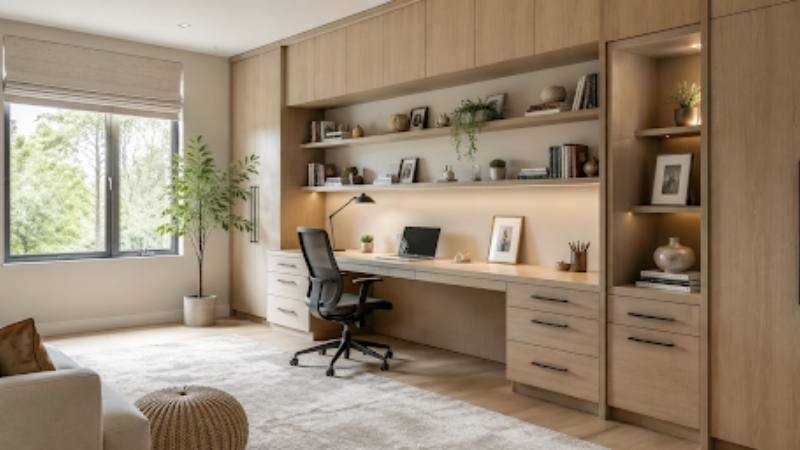
A spare room can look fine until it has to carry a full working week. Then the little faults begin to show. The desk is an inch too shallow. The printer has nowhere sensible to sit. Afternoon light lands straight across the screen.
That is why more homeowners are fitting workspaces around the room itself. For you see, there is no one who wants a household setting that feels too much corporate. In fact, botom line is that they want the feeling to work from home as a short-term phase.
Why Custom Home Offices Have Become a Top Priority for Modern Homeowners
Home working has made people notice rooms that were easy to ignore before. A box room, spare bedroom or landing alcove may suddenly need to handle calls, paperwork plus several hours at a screen.
Freestanding furniture can do the job, but it rarely fits perfectly. There is often an odd gap beside the desk. A cupboard door catches the chair. The printer ends up on the floor because nowhere else quite works.
Fitted furniture can make use of those awkward bits instead of working around them. An alcove that once did very little can take a desk. Shallow cupboards can fit along a narrow wall. Shelving can finish just before the window rather than stealing light from it.
Then there is the clutter.
Files stay in the office instead of appearing on the dining table. Chargers stop travelling from room to room. Notebooks no longer turn up beside the toaster or under a pile of post.
By the end of the working day, everything can simply stay where it is. Hence, judging by that tiny separation becoming a reason among many to produce a proper home office starts to feel worthwhile quite quickly.
How to Design a Home Office That Blends Style and Functionality
The simplest mistake you can ever make is to choose appealing finishes. No less, the type that occurs before making a solid decision that matters. In fact, it actually involves what the space needs to work on.
To begin, one laptop does not ask for much space. Add two monitors, paperwork or a printer and the desk can feel crowded surprisingly quickly. Someone spending most of the day on video calls may also care more about privacy than a large bank of shelves.
A few ordinary details are worth sorting out first:
- Enough desk depth for equipment used every day
- Sockets close enough to avoid cables across the floor
- Storage that can be reached without leaving the chair
- Enough room to move comfortably behind the desk
- Somewhere sensible for a printer or scanner
- After that, the room can start looking more like the rest of the house.
Painted cupboards can almost disappear against the wall. Timber shelves can stop a plain room feeling cold. A darker desktop may also be easier to live with once mugs, pens and keys have been landing on it for a year.
On the whole, you must remember that as soon as the laptop closes, the room should not still look like work has taken over. Not to mention, a good office interior design will work with such elements.
Top Interior Design Trends for Custom Home Offices in 2026
What’s more to know is the distinct charm you will have in the space. After all, the catch is how the newer look is warmer, calmer and much less like a small office dropped into the house.
The bright white room with a black desk still exists, but warmer finishes are becoming easier to spot. Timber, muted greens, soft browns and deeper painted cabinetry bring a little more character without making the room distracting.
First off, that typical open shelving is becoming more selective too. A wall full of shelves can look impressive before anything is put on it. In fact, just after six months or so, it may be holding spare cables, old notebooks and things nobody knew where else to put.
A few shelves usually do the job. The messier items can sit behind doors.
Technology is disappearing into the furniture as well. Chargers can stay inside drawers. Cable holes can be placed exactly where they are needed. A printer can have its own cupboard instead of being the first object seen from the doorway.
Video calls have even changed the wall behind the chair. It does not need to resemble a carefully arranged studio. A framed print, a short shelf or a few books can be enough.
Flexible pieces are useful too. Shelves that move or a small standing section can give the room another use later. Work habits change. The furniture should have enough give to change with them.
How Lighting and Natural Light Improve Home Office Productivity
The matter of lighting issues is that they often arrive on the late time of the day.
A desk can feel perfectly comfortable at nine in the morning. By three, the sun has moved across the room and there is a bright reflection sitting over half the screen.
Facing the window is not always the best answer. A desk placed slightly to one side can still pick up plenty of daylight without taking the full glare.
The room itself makes a difference. Western light may become quite strong late in the afternoon. A darker north-facing room can need help much earlier, particularly through winter.
One ceiling fitting is often too blunt for everything. A small desk lamp is useful for paperwork. Another softer light elsewhere in the room can make late afternoon work feel less stark once the daylight starts disappearing.
The view outside has its own quiet benefit. As you start looking away from a screen for a moment towards a garden, you will notice a difference from the neighbouring rooftops. As well as how even a patch of sky gives the eyes a short break.
Simply put, a typical home office does not need to glow from every corner. It needs to stay comfortable when four o’clock arrives and there is still work left to finish.
How a Custom Home Office Adds Value to Your Property
A fitted office can give a forgotten room a proper reason to exist.
A box room that used to hold suitcases may suddenly be used four days a week. An awkward recess can become useful desk space. Meanwhile, there is the matter for built-in cupboards delivering notable perks. For one thing, they enhance storage, while aligning in the centre of the room, even if it has extra items.
That is value in everyday terms.
Resale is a different question because the next owner may have no interest in working from home.
This is where a little flexibility helps. A desk fitted between cupboards could later become a dressing table. Shelves can take books, toys or household storage. Closed cabinets rarely become useless just because the room changes purpose.
Highly specific layouts can be harder to inherit. A desk built around three large monitors might be exactly right today but frustrating for someone hoping to turn the room back into a bedroom.
The better approach leaves some breathing room. The office can suit the current household without deciding exactly how the room must be used ten years from now.
Conclusion
A home office starts feeling permanent when the small annoyances disappear. The cables have a place, the desk fits properly and paperwork no longer spills into the rest of the house.
All in all, if you want an artful but no less, professional setting, It does not need to look elaborate. It just needs to make the working day easier while still feeling like part of the home. Visit Kitchen Upgrading Tips MintPalment for more details.