
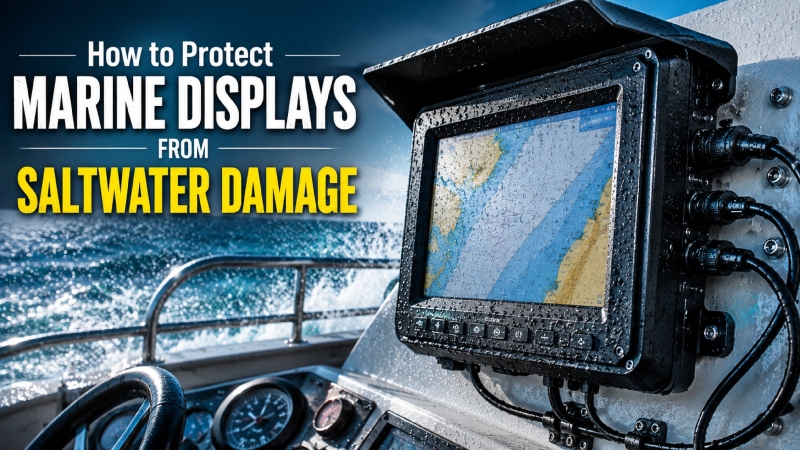
Marine displays operate in one of the most challenging environments for electronic equipment. Unlike displays used inside offices or standard industrial facilities, marine screens can be exposed to saltwater, humidity, spray, condensation, sunlight, vibration, and changing temperatures.
Saltwater is particularly problematic because it can leave conductive and corrosive deposits on exposed surfaces. If moisture reaches connectors, mounting hardware, or internal components, it can contribute to corrosion and eventually affect display performance.
Choosing a suitable marine display is the first step. However, proper installation, cleaning, maintenance, and environmental protection are equally important.
Here are practical ways to help protect marine displays from saltwater damage and extend their service life.
Why Saltwater Is a Problem for Displays
Saltwater contains dissolved salts and minerals that can become corrosive when they remain on equipment surfaces.
When seawater spray reaches a display, the water may eventually evaporate while leaving salt residue behind. Repeated exposure can create a buildup around bezels, connectors, mounting points, and other areas.
The problem becomes more serious when salt deposits combine with moisture.
Corrosion can affect metal components and electrical connections over time. In severe cases, it may contribute to connection problems, degraded components, or equipment failure.
For this reason, marine display protection should focus on preventing moisture and salt from reaching vulnerable areas in the first place.
Choose a Display Designed for Marine Environments
Protection starts with the right equipment.
A standard commercial monitor may not be designed for continuous exposure to marine conditions. Marine grade lcd panels are built with environmental requirements in mind and can include features intended for applications involving moisture, humidity, vibration, and outdoor visibility.
When selecting a marine display, review its published environmental specifications.
Important factors can include:
- Water and moisture protection
- Enclosure construction
- Ingress protection rating
- Operating temperature range
- Humidity tolerance
- Corrosion resistance
- Vibration resistance
- Screen brightness
- Anti-glare characteristics
- Mounting options
The exact requirements depend on where the display will be installed.
A screen mounted inside a protected marine control room may have different requirements from one installed on an exposed bridge or outdoor vessel equipment area.
Pay Attention to Ingress Protection Ratings
Ingress protection, often referred to as an IP rating, can help determine how well an enclosure is designed to protect internal components from solids and liquids.
The rating consists of two digits.
The first relates to protection against solid particles, while the second relates to protection against liquids.
For marine applications, the liquid protection portion deserves particular attention.
However, an IP rating should not be treated as a guarantee that a display can withstand every type of saltwater exposure.
Users should review the manufacturer’s specifications and understand the conditions under which the rating applies.
Direct water jets, temporary splashes, continuous spray, immersion, and condensation can present different challenges.
Protect Exposed Connectors
Connectors are among the areas that deserve special attention in marine installations.
Even when the main display enclosure provides strong protection, poorly protected connections can create an entry point for moisture.
Where appropriate, connectors should be positioned away from direct spray and protected according to the manufacturer’s installation requirements.
Cable glands, sealed connectors, protective covers, and appropriate routing can help reduce unnecessary exposure.
Unused ports should also be protected when the display manufacturer provides suitable covers or sealing accessories.
Avoid leaving connectors unnecessarily exposed to the marine environment.
Install the Display in the Right Location
Where a marine display is installed can have a major effect on its long-term condition.
If possible, position the display where it has some protection from direct seawater spray without compromising visibility or access.
For example, a covered mounting position may reduce the amount of saltwater reaching the enclosure.
However, protection from spray should not interfere with ventilation or cooling requirements.
The display should also be positioned so that cables and connectors do not create areas where water can collect.
Good installation planning can reduce environmental exposure before maintenance is even considered.
Use Proper Cable Routing
Cable routing is more important in marine environments than it may initially appear.
Cables should be routed in a way that prevents water from traveling directly toward connectors.
Where appropriate, a downward cable loop can help prevent water running along the cable from reaching an electrical connection. This is commonly known as a drip loop.
The exact routing should follow the equipment manufacturer’s installation requirements.
Cables should also be secured properly to reduce movement caused by vibration or vessel motion.
A clean installation can reduce both moisture exposure and mechanical stress.
Clean Salt Residue Regularly
Regular cleaning is one of the simplest ways to reduce salt buildup.
Salt residue should not be allowed to accumulate on the display surface, bezel, housing, mounting hardware, or other exposed areas.
Use the cleaning method recommended by the display manufacturer.
In general, avoid aggressive chemicals, abrasive materials, or excessive water during cleaning. These can damage protective coatings, seals, or the display surface.
A soft, appropriate cleaning cloth can be used for the screen when permitted by the manufacturer’s instructions.
The goal is to remove salt and other contaminants without introducing additional moisture into sensitive areas.
Do Not Spray Water Directly Onto the Display
Even a water-resistant marine display should not automatically be treated as equipment that can be freely sprayed.
Directly spraying a display can force water toward seams, connectors, buttons, vents, or other openings.
Instead, follow the manufacturer’s recommended cleaning procedure.
If the equipment requires cleaning after exposure to saltwater spray, use a controlled method that minimizes the chance of water reaching vulnerable areas.
Water resistance and unrestricted water exposure are not the same thing.
Watch for Condensation
Saltwater is not the only moisture concern.
Condensation can develop when equipment experiences significant temperature changes.
For example, a display may move from a cool environment to a warm and humid area. Moisture can then form on surfaces or potentially inside equipment if conditions are suitable.
Proper enclosure design and appropriate environmental specifications can help, but installation conditions still matter.
Avoid placing equipment where warm, humid air repeatedly meets cold surfaces.
If condensation is observed, investigate the environmental conditions rather than simply wiping the visible moisture away.
Consider Corrosion-Resistant Mounting Hardware
The display itself is only one part of a marine installation.
Mounting brackets, screws, fasteners, and other hardware can also be exposed to saltwater and humidity.
Using suitable corrosion-resistant hardware can help reduce deterioration around the mounting system.
The correct materials depend on the vessel, installation location, and manufacturer’s recommendations.
It is also important to inspect mounting points periodically.
Corrosion around fasteners may indicate that the installation is receiving more environmental exposure than expected.
Protect the Screen From Sunlight
Marine displays often operate outdoors or in areas with strong ambient light.
Direct sunlight can make screens harder to read and may contribute to thermal stress.
A suitable marine display may use a high-brightness panel designed for improved visibility in bright environments.
Anti-glare treatments can also help reduce reflections.
Where practical, a protective visor or shaded mounting position can reduce direct sunlight while improving viewing comfort.
This can provide another layer of protection without interfering with normal operation.
Inspect the Display Regularly
Routine inspections can identify problems before they become serious.
Check for:
- Salt deposits
- Corrosion
- Damaged seals
- Loose mounting hardware
- Cracked housings
- Moisture around connectors
- Damaged cables
- Unusual screen behavior
- Failing buttons or controls
Pay particular attention to areas where different materials meet.
Small signs of corrosion or seal damage can become larger problems when the display continues to operate in a saltwater environment.
Avoid Unapproved Modifications
It may be tempting to drill additional holes, modify the enclosure, or change connectors to make installation easier.
However, modifications can compromise the environmental protection provided by the original design.
A new opening can create an entry point for moisture. Changes to mounting structures can also affect the enclosure or cable sealing.
Before modifying a marine display, check the manufacturer’s installation documentation and determine whether the modification is permitted.
Using purpose-built accessories is generally preferable to creating improvised solutions.
Marine Displays Need Both Protection and Maintenance
A rugged marine display can provide important protection, but no piece of equipment should be considered maintenance-free.
Even a well-sealed display can be exposed to salt deposits on its exterior.
The best approach combines suitable equipment with good installation practices and regular inspection.
Businesses and vessel operators should consider the complete installation rather than focusing only on the display itself.
The enclosure, connectors, cables, mounting hardware, ventilation, cleaning process, and surrounding environment all contribute to long-term reliability.
Choosing the Right Marine Display
Before purchasing a marine display, identify the conditions it will experience.
Consider whether the display will be:
- Installed indoors or outdoors
- Exposed to direct seawater spray
- Located near the vessel’s deck or bridge
- Exposed to high humidity
- Subject to vibration
- Used in direct sunlight
- Operating continuously
- Mounted in a fixed or mobile position
These factors can help determine the appropriate display specifications.
Rackmount Sales provides display solutions for demanding professional applications, including environments where durability, visibility, and reliable installation are important considerations.
The correct marine display should be selected according to its documented environmental specifications rather than simply its appearance or screen size.
Final Thoughts
Saltwater can be highly damaging to electronic equipment when exposure is repeated or moisture reaches vulnerable components.
Protecting a marine display requires more than choosing a water-resistant enclosure. Proper mounting, cable routing, connector protection, cleaning, corrosion-resistant hardware, and routine inspections all play an important role.
Start by choosing a display designed for the intended marine environment. Then reduce unnecessary exposure through careful installation and maintenance.
With the right combination of equipment and preventative care, marine displays can remain easier to maintain and more reliable in challenging saltwater environments. Click for more details.